Firstly, this neighborhood has the best website I've seen to date. Shaw's was good, McKinley Heights and Clifton Heights were good, this one is exceptional. This place sounds like the garden of freakin' eden. I'm a gardener, I'm a lover of local foods and produce, I'm a fan of old buildings; I was giddy to check this neck of the woods out.
After visiting Patch yesterday and ONSL today, I feel as though I've discovered two of the neighborhoods with the most rehab activity and positive improvement going on. I really like it here. This could be the Soulard of the north because of all the row houses. I feel optimistic about the future of this place.
Patch Neighborhood
Keep your eye on the rich kid
You guys have it real easy. I never had it like this where I grew up.See for yourself. Best chapel speech ever.
But I send my kids here because the fact is you go to one of the best schools in the country: Rushmore.
Now, for some of you it doesn't matter. You were born rich and you're going to stay rich.
But here's my advice to the rest of you: Take dead aim on the rich boys. Get them in the crosshairs and take them down.
Just remember, they can buy anything but they can't buy backbone. Don't let them forget it. Thank you.
I have 3 kids...city kids...public school kids...who may be smart enough to pursue higher education. Should they choose said pursuit, this movie and Catcher in the Rye will be mandatory viewing/reading for them in a few years. May the close proximity to underdogs always keep us rooting for those with less or those who are worse off.
Wanted: Outsiders and Immigrants
Most of the grand visions and accomplishments happened when St. Louis was booming and people were making fortunes here. Local philanthropy was alive and well; people were thinking big. The spirit and desire to make the U.S. similar to dense European cities and foster that culture was apparent. An example from Henry Shaw's great vision (starting at age 19 mind you):
The Shaw neighborhood began as a clearing the French called Prairie des Noyers. Much of this expansive natural prairie was purchased by Louisville’s Captain William Chambers in 1816. About the same time, the prairie captivated Henry Shaw, a young man of 19 seeking his fortune. He bought his piece in 1840 to the north and west of Chambers and there he built his country home, Tower Grove House. He also began planning and installing his magnificent garden, now known as the Missouri Botanical Garden.So, with the amazing accomplishments of Susan Elizabeth Blow and Henry Shaw at the front of my mind, I am inspired by the amazing vision these people had to shape our city for the betterment of generations and generations to come. Bravo!
Shaw began dabbling in residential development building Shaw Place, which was a re-creation of a streetscape reminiscent of his childhood in England. The architectural firm of George I. Barnett designed these houses as a model and standard for the homes Shaw wanted to see built around his garden. They also served as rental property, the proceeds benefiting the Garden. When Captain Chambers died, he left his property to his daughter, Mary Tyler, who sold it in the 1890’s to a Kansas City developer. Tyler’s 235 acres became “Tyler Place, a bon ton neighborhood”. Flora Place was the showcase of the area. Its lots sold for $55-65 per front foot.
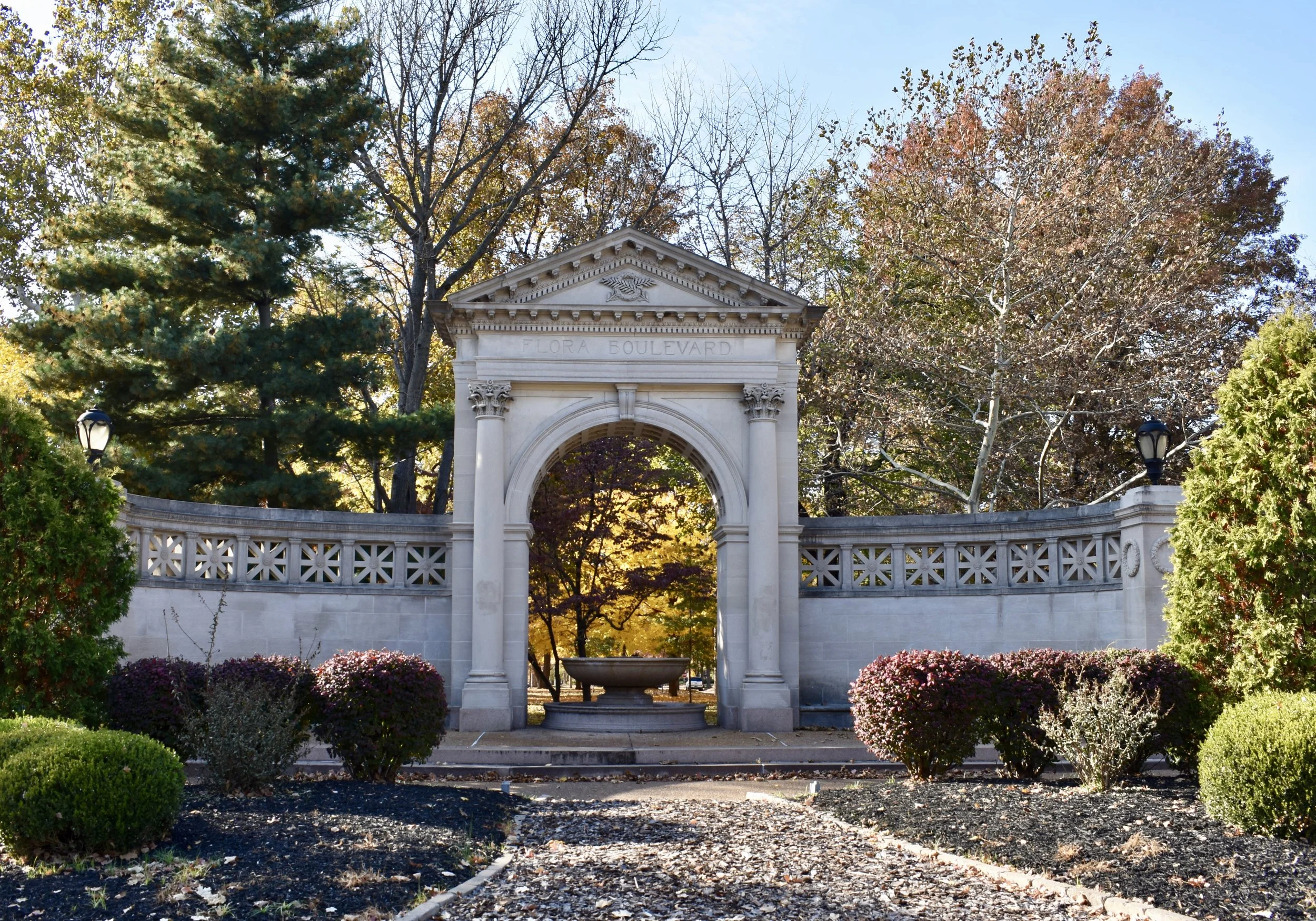
The entrance gates to the 1897 Flora Place were built at a cost of $9,500. That was $5,500 more than the first home’s sale price.
The entrance gates to the 1897 Flora Place were built at a cost of $9,500. That was $5,500 more than the first home’s sale price. Growth spread in all directions, and many styles of architecture flourished over the ensuing 30 years as Shaw became a fully urban neighborhood.
However, the days of America and especially St. Louis being a place where the wealthy and privileged come to live are over. Henry Shaw and Susan Elizabeth Blow probably would not have been able to accomplish what they did without their vast family wealth and privilige. But they were St. Lousians. They lived in the neighborhoods that they designed/worked in. They had personal stock in these places. They wanted to make it a better place for themselves and for generation to come.
Most of the current day wealthy in the region choose to live outside the confines of St. Louis (Ladue, Town and Country, Chesterfield, Frontenac, Creve Coeur, Kirkwood, Webster Groves, etc). Why would they want to make sweeping, lasting, thoughtful changes and contributions to a place where they don't live or understand or have direct stock in?
Henry Shaw lived in his settlement. Susan Elizabeth Blow lived near the school she started. They were part of the neighborhood. They lived in/with the buildings and settlements they designed. That is important. But....
I just don't see St. Louis having the citizens with enough money and power to make radical sweeping changes to this city that is necessary. By change, I mean transforming streets, neighborhoods, fallow parcels of land to places that will be on the map and in the history books in years to come. Places that will be considered special and historically significant 50, maybe 100 years from now.
There are obvious exceptions (Bob Cassilly), but I am generalizing here.
Although, with St. Louis' most wealthy and elite living in the suburbs, enjoying their exclusivity and separation from the negatives of St. Louis race politics, poor, homeless, schools, crime, etc., maybe the saving grace is outside influence....outside the region. I certainly think it will take more than the 350,000 we have now. I think we need help, fresh external viewpoints, intellectual and monitary investment from elsewhere.
On more than one occasion I've given "tours" of St. Louis to suburbanites or metro-east denizens. The usual things are heard. "Should we lock the doors?" "Are you sure it's safe here?" "This could be a nice place." "What a shame it's been allowed to come to this."
Forget all that. I'm sick of that kind of talk. You are either part of the problem or the solution. That kind of talk is part of the regional problem. On more than one occasion, my wife and I have given co-workers from out of country or out of state tours of St. Louis. They are fascinated with the history, the polished neighborhoods, the gritty neighborhoods, the overall feel. They've commented on how cheap it is to eat good food and the accessibility to amazingly affordable housing options. They seem to walk away impressed. It's this fresh, less tainted perspective that I think we need to help guide us toward a brighter future.
We need more outsiders and immigrants to make this place better. The fresh perspective is needed more now than ever. Look at how the Bosnian, Croatian, Roma immigrants have not let local politics, fear of opening a business and negativity get in the way of transforming buildings, blocks, neighborhoods for their community and needs. St. Louis is a better place because of their hard work (and great bakeries).
I'm very hopeful that the solicitation of outsider view points on the Arch Grounds Design Competition jury will inject this sense of optimism and pleasant surprise at how much our city has to offer if it was just reconfigured a little and reconnected with pedestrians in mind. Many other bloggers are already covering the Arch Grounds Design Competition. Take a look at the folks selected to be on the jury (from Ecology of Absence):
Robert Campbell, architecture critic at The Boston Globe and contributing editor for Architectural Record;
Gerald Early, Merle Kling Professor of Modern Letters and Director of the African and Afro-American Studies at Washington University in St. Louis;
Denis P. Galvin, former Deputy Director of the National Park Service;
Alex Krieger, founding principal of Chan Krieger Sieniewicz, architecture and urban design firm and professor at the Harvard School of Design, Cambridge, Mass.;
David C. Leland, an urban strategist and managing director of the Leland Consulting Group, Portland, Ore.;
Cara McCarty, curator of the Smithsonian's Cooper-Hewitt National Design Museum, New York City;
Laurie D. Olin, partner and landscape architect of the OLIN Studio, Philadelphia;
Carol Ross Barney, founder and Principal of Ross Barney Architects, Chicago.
79 St. Louis Neighborhoods: A Process Check
Back in September, 2009 I made it a personal goal to visit and document each of St. Louis' 79 neighborhoods. I've come to the conclusion that it's going to take me years to reach my goal of posting on all 79 neighborhoods in St. Louis at the rate I'm going. It's not that hard, it just takes a lot of time. So far, I've done 9 neighborhoods in 4 months. I'm only 11% of the way toward completion! At this rate it will take me over 3 years to complete this task.
Can't say I have
- Sled down art hill
- Ice skate with the kids in Forest Park
- Eat at Giuseppe's on Grand/Meremec (you've gotta be intrigued by an Italian joint without windows)
- Find a St. Paul sandwich, imbibe
- Attend a Baptist church service
- Try to observe eagles in Grafton
- Explore a Missouri cave
Walnut Park East Neighborhood
As you may be able to grasp from the above entry, this place is struggling. Frankly, the housing stock that exists in WPE was probably never anything out of the ordinary or special in any way. Working class, small, mostly frame houses were built here. The brick bungalows that were built here are not in great enough numbers to be impactful or stand out. The housing in WPE is not really similar to any other neighborhood I've visited so far. Meaning, the structures just aren't that special. This is not as true for Walnut Park West, but I'll get to that in a separate post.
Head North Young Man
I'm once again reaching to my record collection for inspiration and a song to cement these fine memories of Fatherhood into my brain. One of may favorite lyrics from Dave Davies in the Kinks song Strangers:
So you've been where I've just come
From the land that brings losers on
So we will share this road we walk
And mind our mouths and beware our talk
Till peace we find, tell you what I'll do
All the things I own I will share with you
If I feel tomorrow like I feel today
We'll take what we want and give the rest away
Strangers on this road we are on
We are not two we are one
Westward Ho
Fur trading post (and walnut bowls)
Commemorative truck stop mini cannons and shot glasses
Rolls thrown due south of 44
References to the old South and the free North
The middle ground, the coming together of water and people and cultures and transport of the day
With deep caverns lit up like a rainbow
And railing and pavement and view masters
Welcome to St. Louis, Missouri old and today
History is right around the block or the river's bend
It wasn't that long ago when all this beauty mattered
Everyone just up and left.
You can scratch away the dingy surface to unearth the most pleasant reminders of who we are and where we've come from and what we should be saving.
Check it out, it's all there.
Don't fuck it up and knock that building down.
You may not even understand what it was.
It may take years to understand.
You can park over there....
A Salty Salute to Iron Barley
Real like a warm fire burning with the faint smell of smoke but no flame
Real like the E minor chord but not too loud
Real like calling a Busch over a PBR
Real like the neighborhood gathering place for all
Welcome
Rear Entry And Other Urban Niceties
Other urban fixtures I am fond of:
- fire escapes-fell in love with them in NYC, now I'm developing a photo album of ones in STL
- Dining establishments with a bar set in front of large windows overlooking the street. It's fun to enjoy lunch and watch pedestrians walking the sidewalks/streets.
- alleys and alley dumpsters for yard waste and regular trash-I've never owned a home on an alley and I'm jealous of those huge dumpsters. Our next home WILL be on an alley.
- below level or downstairs bars/restaurants. Labeebees DT on 9th street or the old Rosario's (?? is that right ??, memory is foggy) on Sarah are perfect examples.
- High rise patios off condos (CWE, DT and Midtown have some excellent examples). Especially ones with elaborate gardens.
- Train bridges in dense parts of the city-I love walking to Busch stadium from my free parking spot and hearing the slow rumble of coal freight trains above me. At our previous home in Holly Hills, I loved living on a railway for Amtrak and the fancy antique trains that are rented out for weddings, events, etc. from Union Station.
- Windows that open up onto the sidewalk. The gelato place on South Grand is a good example. The former Chez Leon in CWE is another.
- Sidewalk loading receptacles (sorry for the crappy description, I don't know what these are technically called). You know, the metal panels that open up for the UPS guy to send boxes down a ramp to the receiving dept. of the buildings.
ps. what the hell happened to the spell checker on blogger? You'll have to forgive my misspelled words for now....
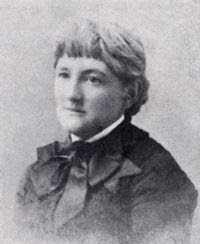
Susan Elizabeth Blow (1843-1916)
I was enjoying a cup of coffee and a banana nut muffin with my lovely wife at
. She was reading
and mentioned something about the first public kindergarten was in St. Louis. I was only half listening as males often do (sorry Shan); but it stuck with me somewhere in the back of my mind.
I was wondering where the school was and who decided to start a Kindergarten in St. Louis; after all, that was a German educational philosophy right? The first Kindergarten in America was actually in
. But the first
publicly financed
Kindergarten was founded by Susan Elizabeth Blow in 1873.
Susan Elizabeth Blow was an amazing St. Louisian and woman in general. Here's the story on her privileged, but certainly not spoiled life (from Wikipedia):
The eldest of six children, Susan Blow was the daughter of Henry Taylor Blow and Minerva Grimsley. Henry owned various lead-mining operations, was president of the Iron Mountain Railroad, was a state senator, and was a minister to Brazil and Venezuela. Minerva was the daughter of a prominent manufacturer and local politician. The Blow children grew up in a deeply religious family surrounded by comfort, wealth, and high German culture. Her grandfather was Captain Peter Blow, the owner of the slaveDred Scott, who later challenged the slavery issue in court.
Due to her family's social status, Blow received her education from her parents, various governesses, private tutors, and schools. At age eight, she was enrolled at the William McCauley School in New Orleans, Louisiana; she attended classes there for the next two years. At age sixteen Blow and her sister Nellie enrolled in the New York school of Henrietta Haines but were forced to return home due to the outbreak of the Civil War. During this time Blow tutored her younger brothers and sister and taught Sunday school at Carondelet Presbyterian Church.
At age twenty, Blow met and fell in love with a soldier named Colonel William Coyle, but her parents found him to be unsuitable. When Coyle was discharged for medical reasons, her father took her to Washington D.C. and introduced her to another military man who was more to his liking. However, Blow chose not to marry.
President Ulysses S. Grant appointed Henry Blow minister to Brazil in 1869, and Susan went with him as his secretary. During the next fifteen months, she quickly learned Portuguese. Her bilingual ability helped to ease trade communications between Brazil and the United States.
In 1870, along with her mother and siblings, Blow went abroad to Europe. She first began studying the philosophies of Hegel and the American Transcendentalists. However, while abroad she came across the kindergarten teaching methods of German idealist and philosopher Friedrich Fröbel. Fröbel believed in "learning-through-play" and cognitive development.
Wow. It's kind of sad that Colonel William Coyle and Susan never got any further.
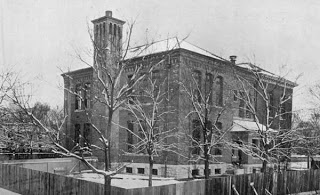
Anyhow, the school was called the Des Peres school, located in Carondelet at Michigan and Iron. Does this still exist? I will try to go by there soon.
Susan Elizabeth Blow was an important leader in education from Missouri. She founded the first public kindergarten in St. Louis and ran it for eleven years without any pay. Blow worked hard to give young children a good start in their education. “If we can make children love intellectual effort,” she once wrote, “we shall prolong habits of study beyond school years.” (source)
That quote warms my heart.
St. Louis is a fascinating place with an amazing history. Our citizens have made monumental contributions to our culture and society. We need more pioneers with this kind of vision. I like living amongst this kind of history.
Vic Chesnutt
To me this sums up both the promise of new American towns as well as the eventual boringness and blandness that new towns leave behind as they age. I'll miss you Vic.
The Shaw Neighborhood
Papa Fabarre's
Okay, I know I just did a post on the
DT
Macy's, but I had to go back to exchange a couple items and stopped into Papa
Fabarre's
on the second floor for lunch. First of all, this place is what it is. And by that I mean a true throwback. I think it rivals Crown Candy Kitchen and
O'Connels
for original, non-pretentious charm.
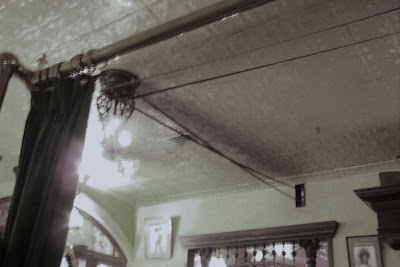
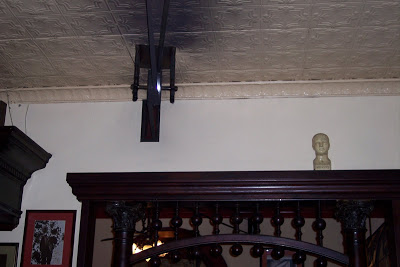
Check out the fully operational pulley's and belts that operate the ceiling fans.
My first job was busing tables at a
Belleville
, Illinois restaurant called
Riedels
. The food reminds me of
Riedels
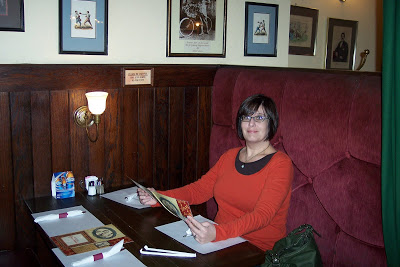
. Good old unhealthy American comfort food. Grilled cheese and chicken on a pretzel bread were our choices. They are famous for their French onion soup which is served in a crock layered with cheese. Soup is a term used loosely here. I would say gravy would be more appropriate. But, people love this stuff. The place was filled to capacity on the Monday we were there. The hostess, waiter and cashier all confirmed that the restaurant will remain open after the reconfiguration of the Macy's down to 3 floors.
They indicated that the future of the St. Louis Room restaurant on the 6
th
floor is still up in the air.
This place is a trip; a great place to take out of
towners
and first timers.
Visitation Park Neighborhood
Visitation Park is a near north city neighborhood with beautiful mansions, incredible architecture and a prominent park. This neighborhood tour was originally published in December, 2009 with updates from July, 2019. The neighborhood is bound by Delmar Boulevard to the south, Belt Avenue to the west, Maple Avenue to the north and Union Boulevard to the east.
Princeton Heights Neighborhood
Princeton Heights is a tidy south city neighborhood that benefits from being near the Macklind Avenue district and the convenience of South City shopping, parks and services. If you like the St. Louis gingerbread, bungalows and Dutch colonial homes, this is one of the spots to find them. This neighborhood tour was originally published in December, 2009 with updates from September, 2019.
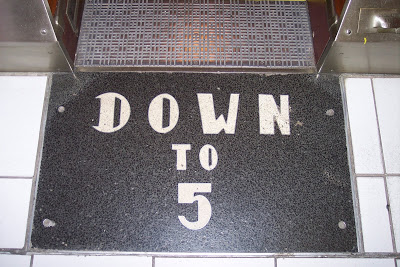
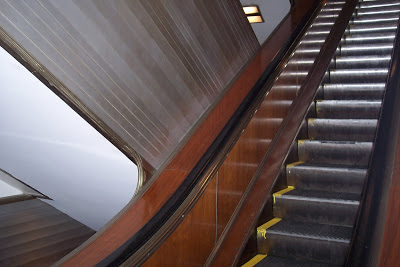
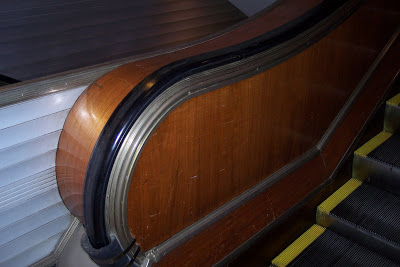
Downtown Macy's Escalator Tribute
I am a big fan of the downtown Macy's. It's in a fabulous building, close to a Metrolink stop and is staffed by kind people. It's got a cool restaurant (Papa Fabarre's), it isn't part of an annoyingly jarring indoor mall and is never overrun with people; no lines (good for customer, bad for retailer).
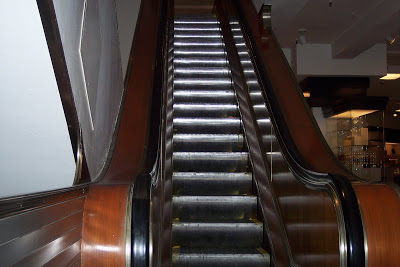
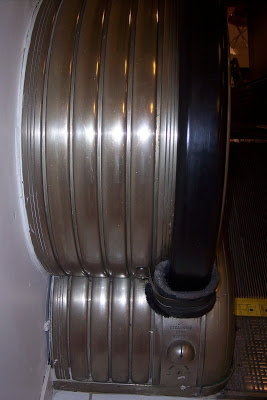
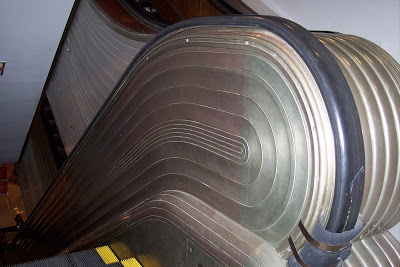
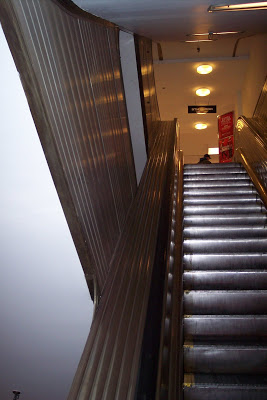
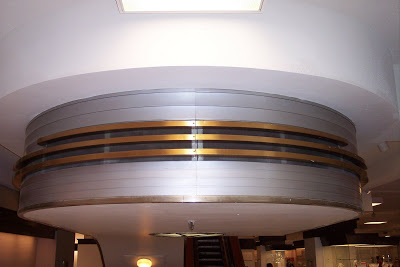
Obviously, I am happy that Macy's is going to keep this location open. Yet, I'm sad that they are downsizing it. Not because of the loss of goods and retail square footage, but because of the escalators. Man I'm a dork, I know it, but damn it, I will desperately miss the varied styles of escalators in this department store. From the old school wood to the brushed stainless steel art deco ones to the more modern glass ones like you see today. I fear these will go the way of the typewriter during the remodeling. I hope not, but I fear the worst. Here's my photo tribute to a department store and escalators that have soul:
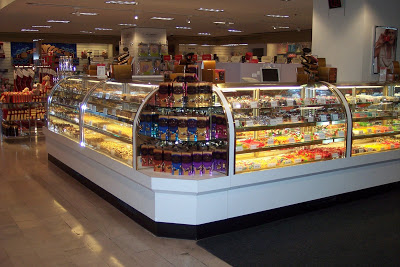
My kids love getting Swedish fish at the candy counter:
I will miss the marble floors too.